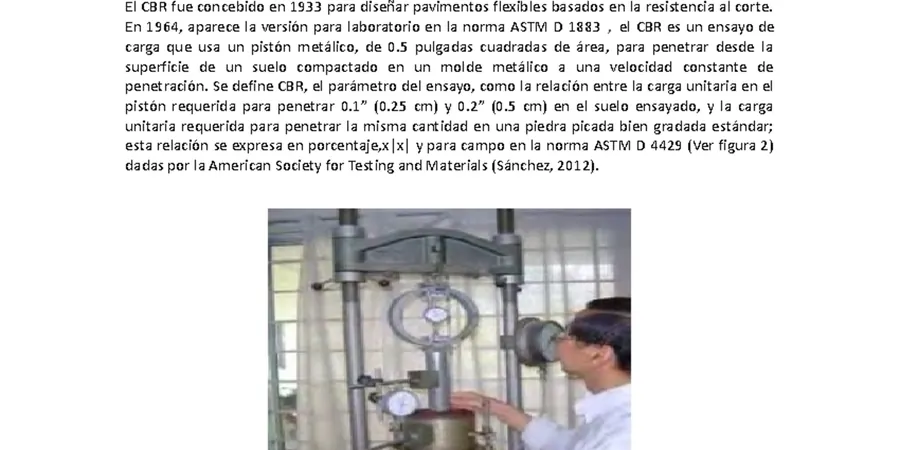
The CBR press in our Darwin lab sits in a controlled-temperature room because the ambient humidity up here plays tricks on moisture conditioning. We run the California Bearing Ratio test on a calibrated loading frame with a 50 kN capacity, pushing a 49.6 mm diameter plunger into a compacted specimen at exactly 1 mm/min. The load readings at 2.5 mm and 5.0 mm penetration tell you how the subgrade will hold up under traffic. In Darwin, we deal with lateritic gravels that look solid in the dry season but turn to mush once the monsoon saturates them. That soaked CBR value we measure after four days immersion in water is the number that really matters for pavement design here. We see plenty of projects where the unsoaked result looks fine at 35%, but the soaked drops below 5% and suddenly the pavement thickness needs rethinking.
A soaked CBR of 3% versus 8% can double the required pavement thickness. In Darwin's monsoonal climate, that number determines whether a road survives its first wet season or fails before the defects liability period ends.
Technical details of the service in Darwin
Risks and considerations in Darwin
The mistake we see too often in the Top End is designing pavements from unsoaked CBR values taken in August. The soil looks fantastic, the contractor quotes a thin pavement, and by February the road base is pumping fines through the seal under heavy wet-season traffic. Darwin's average annual rainfall sits around 1,700 mm, and almost all of it falls between November and April. A subgrade that tests at CBR 25 unsoaked can drop to CBR 3 soaked, and the Austroads pavement design method runs on the soaked value. Another problem is using 4-day soak results when the water table is permanently high; in suburbs like Karama or Ludmilla, we recommend extending the soak to 10 days to better represent field equilibrium. The lab test costs a fraction of what a pavement failure costs, yet we still get samples with no chain of custody, no compaction reference, and a note saying 'just give us a number'. Without knowing the target density ratio and moisture condition, the CBR number is meaningless.
Our services
Our Darwin CBR testing service covers the full sequence from sample preparation through to a signed report. We handle bulk samples from subdivisions, highway projects, and mining access roads across the greater Darwin region.
Soaked CBR with swell measurement
Four-day immersion under standard surcharge with continuous swell readings. We report CBR at 2.5 mm and 5.0 mm penetration plus the swell percentage and moisture content before and after soaking.
Unsoaked CBR for expedited results
For projects needing quick screening during the dry season. We test specimens at compaction moisture without soaking, suitable for preliminary assessments and borrow pit reconnaissance.
CBR vs. density relationship curves
Three-point or five-point compaction series at varying moisture contents to establish the CBR envelope. Essential for value engineering pavement thickness across a variable subgrade.
Frequently asked questions
How much does a laboratory CBR test cost in Darwin?
A standard soaked CBR test on a single specimen in Darwin typically costs between AU$170 and AU$280 depending on whether you need the full swell measurement and density relationship. A three-point CBR series to establish the strength-moisture curve runs higher because it involves multiple compaction and soaking setups. We provide a firm quote once we know the number of specimens and the conditioning required.
How long does it take to get CBR results from your Darwin lab?
For a soaked CBR, allow a minimum of five working days: one day for compaction and setup, four days for the soaking period, and half a day for the penetration test and reporting. Unsoaked CBR results can be turned around in two working days. We can accommodate urgent requests, but the four-day soak is physically necessary for the standard method.
What size soil sample do you need for a CBR test?
We need roughly 25 kg of material passing the 19 mm sieve for a single specimen. If the material contains oversize particles above 37.5 mm, we can scalped-replace following AS 1289.5.4.1, but you should discuss this with us beforehand because the replacement method affects the result. Bulk samples should be sealed in plastic bags immediately after excavation to preserve field moisture.
Why does my soaked CBR value drop so much compared to the unsoaked result?
In Darwin's lateritic soils, the drop happens because the iron oxide cementation that gives dry strength dissolves or softens with prolonged water exposure. The clay fraction swells, pore pressure increases, and the effective stress between particles collapses. That is exactly why soaked CBR is the design value. The difference between unsoaked and soaked CBR is a direct indicator of how moisture-sensitive your subgrade is. More info.