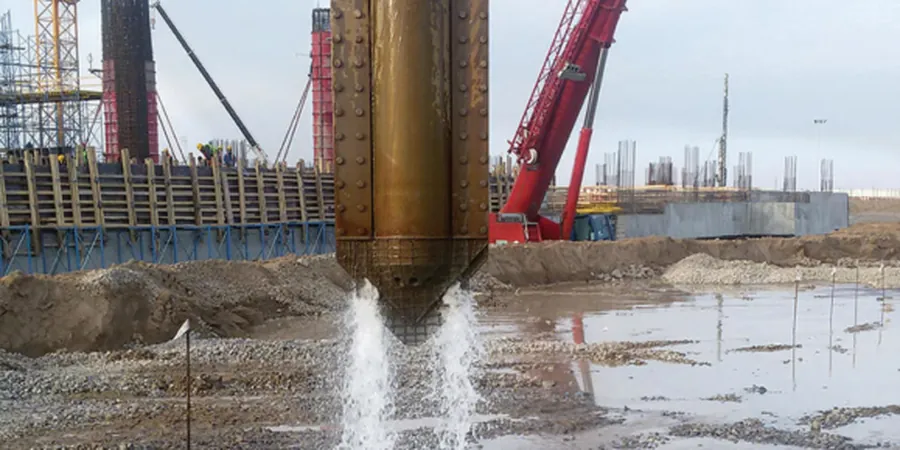
The deep vibrator hangs from a crawler crane on a Winnellie industrial plot, its V23 power-pack humming at 1800 rpm while the probe penetrates the saturated sand. Darwin's subsurface is notoriously variable — the city sits atop a complex mix of lateritic gravels, estuarine muds, and loose sandy deposits from the ancient Palmerston coastal plain, where the water table often sits just 2 to 3 meters below ground level. Our vibrocompaction design team works with this equipment profile daily, specifying probe dimensions, grid spacing, and power-amperage targets that match the grain-size distribution of each site. The goal is straightforward: trigger liquefaction in a controlled manner to rearrange sand particles into a denser state before any structure is built, eliminating future settlement risk in a city where tropical downpours and Category 4 cyclones like Tracy have reshaped entire neighborhoods. We often integrate these designs with in-situ permeability testing to verify drainage paths remain open after treatment.
In Darwin's loose sandy profiles, vibrocompaction transforms a site from liquefaction-susceptible to structurally competent in a matter of days, eliminating the need for deep piled foundations.
Technical details of the service in Darwin
Risks and considerations in Darwin
A four-storey apartment development in the Stuart Park area encountered loose sand lenses at 6 meters depth during initial site investigation, with SPT N-values below 8 and a fines content of just 4 percent — classic liquefiable material in a city where seismic events, though infrequent, can originate from the Banda Sea tectonic zone to the north. The developer initially considered a piled solution that would have added AU$400,000 to the foundation budget for just 32 units. Our vibrocompaction design reduced the foundation cost by approximately 60 percent: we specified a 2.2-meter triangular grid with a V23 vibrator, achieving post-treatment CPT tip resistances above 18 MPa across the entire footprint, confirmed by independent testing. The building now sits on conventional shallow footings with total settlements under 10 mm — a result that demonstrates why ground improvement economics often win in Darwin's competitive construction market when the soil profile cooperates.
Our services
Our vibrocompaction design services cover the full project lifecycle from feasibility assessment through construction monitoring and post-treatment verification, always calibrated to Darwin's specific geological conditions and the regulatory framework of the Northern Territory Building Code.
Feasibility Studies and Soil Suitability Assessment
We review existing borehole logs, grain-size curves, and CPT data to determine whether the subsurface profile meets vibrocompaction suitability criteria. The assessment identifies zones where fines content or gravel layers may require hybrid approaches, and we deliver a go/no-go recommendation with preliminary grid layouts and depth targets.
Detailed Treatment Design and Specification
Complete design package includes probe spacing calculations, compaction point coordinates, power-amperage curves for each depth interval, water flush specifications, and a quality control plan with acceptance criteria. We also prepare the performance specification for contractor tendering, ensuring competitive pricing while maintaining technical rigor.
Post-Treatment Verification Testing
Independent verification using CPT, SPT, or geophysical methods to confirm that the specified relative density targets have been achieved across the entire treatment zone. We compare pre- and post-treatment data and issue a compliance certificate recognized by Northern Territory building surveyors for foundation design sign-off.
Frequently asked questions
What does vibrocompaction design cost for a typical Darwin residential project?
For a standard residential subdivision or small commercial lot in Darwin, vibrocompaction design fees typically range from AU$2,010 to AU$6,950 depending on site area, depth of treatment, and the number of verification tests required. A single dwelling site with treatment to 10 meters depth and one day of post-treatment CPT verification would fall toward the lower end of that range.
How do you determine if a Darwin site is suitable for vibrocompaction?
Suitability depends primarily on the fines content passing the 75-micron sieve — we need values below 12 percent for the method to work efficiently. We also evaluate the grain-size distribution curve, SPT or CPT data from the site investigation, and the presence of any continuous clay layers that could block drainage during treatment. Sites in the Ludmilla and Coconut Grove areas with clean sand deposits often prove ideal, while locations with thick estuarine clays require alternative approaches.
How long does the design and approval process take for a vibrocompaction project?
The design phase typically takes 5 to 8 working days from receipt of complete site investigation data, assuming the soil profile has already been characterized with sufficient CPT or SPT soundings. The design package then goes to the contractor for pricing and scheduling, and the actual treatment for a typical Darwin commercial lot can be completed in 2 to 4 days, followed by a 14-day waiting period before verification testing.
What depth can vibrocompaction reach in Darwin's geology?
With the equipment we specify — typically V23 or V32 vibrators — effective treatment depths of 30 to 35 meters are achievable in Darwin's sands, though most projects in the city target depths between 8 and 20 meters where loose deposits are most common. The limiting factor is usually the underlying Cretaceous sandstone, which acts as a natural refusal surface and defines the base of the treatable zone.