The first thing we set up on a Darwin site is a total station with a decent data collector and a series of fixed prisms on the batter face. You need to see how the lateritic profile moves after the first wet season rains hit. Darwin's soil isn't just one material; it's a profile of highly weathered phyllite and siltstone, often with a duricrust cap that gives a false sense of security. We combine surface monitoring with borehole inclinometers to track the actual shear plane, a method that directly informs the back-analysis for any retaining wall design you might be considering. The city's average annual rainfall of over 1700 mm, concentrated in a few months, makes pore-water pressure the single biggest variable in any local stability model.
A factor of safety of 1.5 on paper means nothing if your effective cohesion drops to zero after a cyclone.
Technical details of the service in Darwin
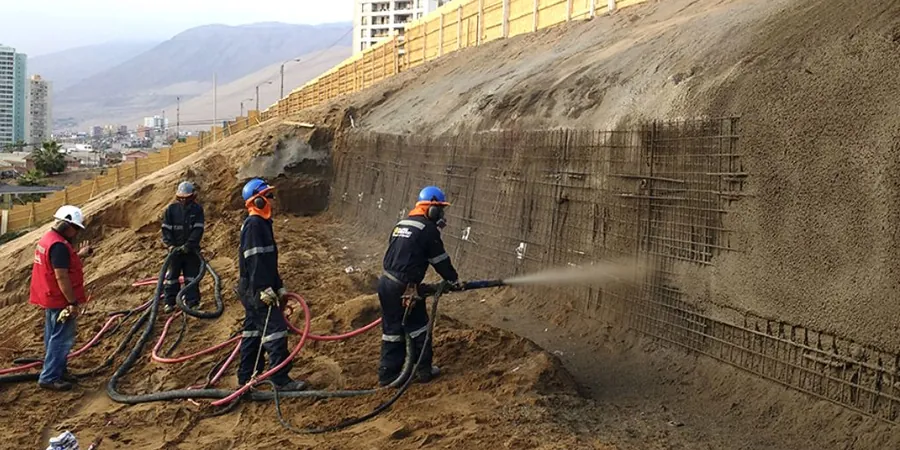
Risks and considerations in Darwin
The risk profile between a waterfront site in Bayview and an inland development in Berrimah is completely different. In Bayview, you're dealing with a fluctuating tidal groundwater level that acts as a permanent seepage force at the toe of the slope, accelerating erosion and reducing effective stress. In Berrimah, the problem is often relic jointing in the weathered rock mass that controls the kinematic failure modes, like wedge sliding along two intersecting discontinuities. A slope that looks stable in August can be on the verge of failure by February if the drainage hasn't been designed for a 1-in-100-year rainfall event. We always push for a comprehensive field permeability test in the upper colluvium layer because without that hydraulic conductivity value, any pore-pressure ratio (ru) you assign is just a guess.
Our services
Our slope stability work in the Top End covers the full lifecycle of your earthworks project, from the initial desktop study to the construction-phase instrumentation reading.
Limit Equilibrium Analysis (LEM)
We build 2D models in Slide2 or Slope/W using site-specific shear strength data from our NATA-accredited lab. We don't use textbook parameters for Darwin's lateritic soils; we test the actual material to get the c' and φ' values that hold up under audit.
Cut and Fill Design Verification
For residential subdivisions and commercial pads, we check the global stability of the proposed earthworks. This includes modelling the staged construction sequence and the influence of the wet season on the phreatic surface.
Remedial Design for Failed Slopes
If you have an existing slip, we map the scarp, install inclinometers to find the active shear zone, and design a remediation using a combination of sub-horizontal drains and reinforced soil to restore the design life of the asset.
Frequently asked questions
What is the typical cost range for a slope stability analysis in Darwin?
For a standalone residential or small commercial cut analysis, budget between AU$1,710 and AU$7,270 depending on the complexity of the geology and the number of cross-sections modelled. A full commercial development with extensive site investigation and multiple critical slip surface searches will be at the upper end of that range, reflecting the cost of the triaxial testing and detailed reporting required.
Which design standard do you use for slope stability in Darwin?
We design to AS 4678-2002 for earth-retaining structures and general slope stability. The seismic coefficient is derived from AS 1170.4-2007, which places Darwin in a moderate hazard zone. We also follow the sampling and testing protocols of AS 1726-2017 to ensure the input parameters are legally defensible.
How does the Darwin wet season affect slope stability?
The monsoon rainfall saturates the upper soil layers, destroying the negative pore-water pressure (matric suction) that provides apparent cohesion in the dry season. This causes a rapid drop in the factor of safety. Our models always include a saturated phreatic surface scenario parallel to the slope face to simulate these worst-case conditions, plus we factor in the effect of any broken stormwater pipes which are a common trigger for local failures.
What is the minimum factor of safety required for a permanent cut?
For a permanent soil cut under static conditions, AS 4678 recommends a minimum factor of safety of 1.5 against deep-seated failure. For temporary works during construction, a lower FoS of 1.2 to 1.3 may be acceptable if the exposure time is limited to the dry season months. We always clear the acceptance criteria with the certifying engineer before starting the analysis.