Darwin’s monsoonal climate creates extreme moisture cycles that most standard wall designs simply cannot handle. Intense wet-season saturation followed by prolonged dry-season shrinkage generates significant lateral earth pressure variations behind any retaining structure. Our laboratory has measured moisture content swings exceeding 40% in the upper 2 metres of the lateritic clay profiles common across the northern suburbs. This is why retaining wall design in Darwin must start with site-specific soil characterization—AS 4678:2002 explicitly requires it. We combine in-situ test pits for visual profiling with laboratory atterberg limits to quantify the shrink-swell potential that governs backfill behavior. The Darwin CBD’s elevation of just 30 metres above sea level means groundwater is often less than 2 metres deep, adding hydrostatic loading that must be accounted for in every drainage design.
A Darwin retaining wall lives through 1,700 mm of annual rainfall concentrated in just four months—drainage is not an accessory, it is the primary design constraint.
Technical details of the service in Darwin
Key design parameters we quantify include:
- Drained friction angle (φ') and effective cohesion (c') from multi-stage triaxial testing
- Unit weight and saturation ratio under both dry and fully saturated conditions
- Interface friction between backfill and geotextile or granular drainage layer
- Swell pressure from oedometer testing on undisturbed clay specimens
- Permeability of retained soil and foundation strata for drainage design
Risks and considerations in Darwin
Post-Cyclone Tracy rebuilding reshaped Darwin’s built environment, but many older retaining structures predate modern geotechnical standards. These unreinforced masonry or sleeper walls are now reaching the end of their service life, often showing signs of rotational failure or base sliding. The risk is compounded by Darwin’s reactive soils—cyclic swelling and shrinking progressively reduces backfill density and increases wall movement over time. A wall designed without accounting for this progressive deformation may appear stable during the dry season but will displace noticeably after the first major wet-season soaking. We see this pattern frequently in the Nightcliff and Rapid Creek areas where natural drainage paths concentrate groundwater flow. Our approach incorporates long-term drained strength parameters rather than peak values, explicitly modeling the softened state that governs long-term wall performance.
Our services
Our Darwin retaining wall design service covers the full project lifecycle, from pre-construction site investigation through to construction-phase verification testing. We operate a NATA-accredited laboratory in Berrimah, which means turnaround on soil classification and strength testing is measured in days, not weeks.
Cantilever and Gravity Wall Design
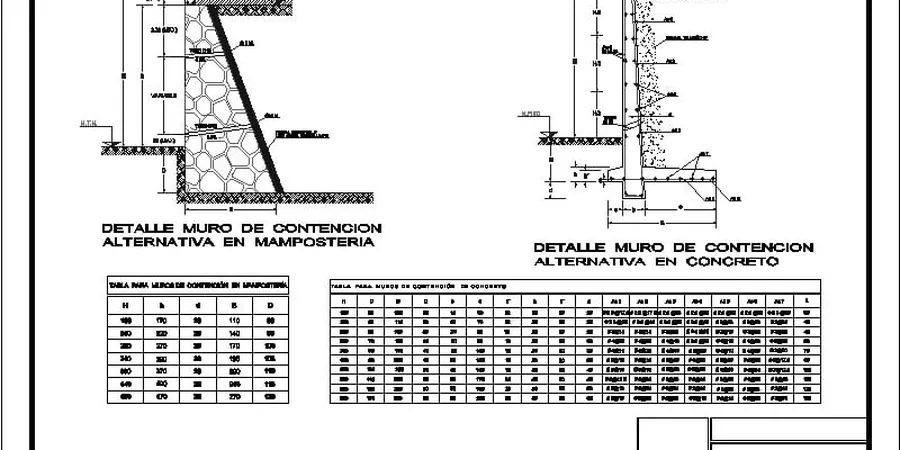
Full geotechnical design package including bearing capacity assessment, sliding and overturning checks, global stability analysis, and drainage specification. We provide construction-ready drawings with reinforcement schedules for reinforced concrete cantilever walls and mass concrete gravity walls up to 6 metres retained height.
Construction Verification Testing
Field density testing of backfill compaction using nuclear gauge or sand cone methods per AS 1289. We verify granular drainage layer gradation, geotextile placement, and foundation preparation prior to wall construction. Hold-point inspections documented with NATA-endorsed reports.
Frequently asked questions
What does retaining wall design cost for a typical Darwin residential project?
For a standard residential retaining wall in Darwin, the geotechnical investigation and design package typically ranges from AU$1,630 to AU$6,680, depending on wall height, soil variability, and whether the site is in a cyclonic exposure zone. The cost includes site investigation, laboratory testing, design calculations, and a signed design report compliant with AS 4678.
How do Darwin’s monsoon conditions affect retaining wall design?
Monsoon rainfall saturates the backfill, dramatically increasing lateral earth pressure. Our designs assume fully saturated conditions behind the wall for the wet-season case, with drainage systems sized to handle Darwin’s intense short-duration rainfall events. We specify free-draining granular backfill and ensure weep holes or strip drains are adequate to prevent hydrostatic pressure buildup.
What soil parameters are critical for retaining wall design in the Darwin region?
The three most critical parameters are effective friction angle (φ'), effective cohesion (c'), and the soil’s swell-shrink potential. Darwin’s lateritic clays can develop swell pressures exceeding 100 kPa when wetted. We routinely run oedometer swell tests and consolidated-undrained triaxial tests to quantify these values before any wall geometry is finalized.