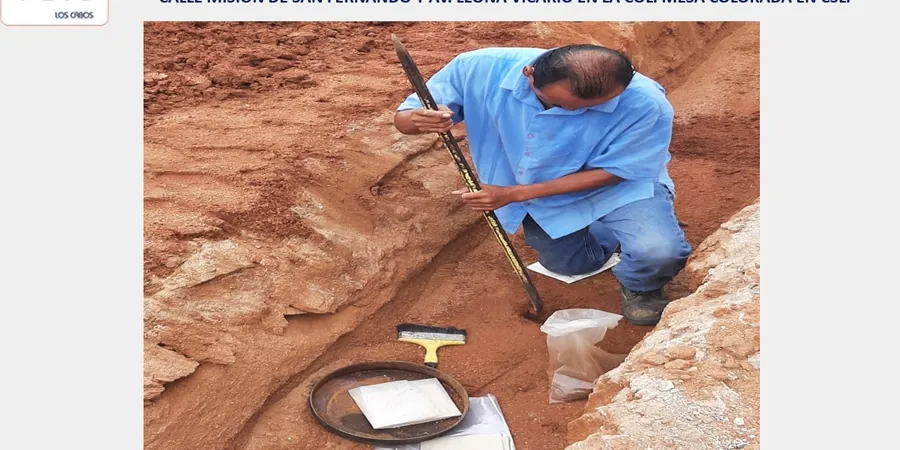
In Darwin, we often uncover surprises at the 600 mm mark. The monsoonal wet season leaches fines and leaves behind a stiff clay crust that looks competent until you go deeper and hit saturated sandy clay or loose lateritic gravel. Builders call us after punching a bucket through what they thought was ‘good ground.’ Our exploratory test pits give you a logged, photographed, and sampled vertical profile before the excavator arrives on site. We open pits up to 4.5 m depth using a 5-tonne excavator, log strata to AS 1726, and take bulk samples for lab index testing. In Cullen Bay or Nightcliff where the top layer is fill over Darwin member siltstone, a well-placed test pit saves more than it costs. We also use grain size analysis on site to flag reactive fines right at the face.
A two-metre test pit in Darwin’s lateritic profile often tells you more about foundation risk than a dozen SPT blows.
Technical details of the service in Darwin
Darwin sits on deeply weathered Cretaceous sediments and Cenozoic laterite, overprinted by Holocene estuarine clays along the coastal fringe. This geology produces abrupt changes in bearing capacity within a single house pad, which is why we push for at least three pits per lot and log them to a common datum. Our team carries a NATA-endorsed field kit and can deliver a stamped log within 48 hours.
Demonstration video
Risks and considerations in Darwin
The most common mistake we see in Darwin is treating a single test pit as a whole-site characterisation. Tropical residual soils change laterally over a few metres. A builder who digs one pit in the corner of a block and assumes the profile is uniform risks founding a slab on two different materials—one stiff, one compressible—which is a recipe for differential settlement cracks before the first wet season. Another frequent error is ignoring the perched water table that forms in the transition zone between the lateritic crust and the underlying clay. We have measured 300 mm of free water in pits at 1.5 m depth in Rapid Creek just 48 hours after a storm, while the surface looked bone dry. Without a properly logged pit and a drainage mitigation note in the report, the footing design is guessing. We flag these risks in the field, not weeks later in an office.
Our services
Our Darwin exploratory test pit service is built around speed and site safety, without cutting corners on the geotechnical detail. Whether you need a single pit for a shed slab in Humpty Doo or a grid of five pits for a multi-unit development in Stuart Park, we provide the same NATA-backed logging and sampling protocol.
Standard exploratory test pit package
Machine excavation to 3.0–4.5 m, full AS 1726 log with colour photographs, bulk sampling at each stratum change, in-pit groundwater observation, and backfill compaction. Includes a stamped field report and chain-of-custody for lab samples. Suitable for residential slabs, small commercial footings, and retaining wall design on sites with good access.
Combined pit and lab index program
Test pit plus NATA-accredited testing on recovered samples: particle size distribution, Atterberg limits, Emerson class, and pH/conductivity. We add a factual geotechnical report with bearing capacity estimates and a site classification to AS 2870 where applicable. Ideal for builders who need a single package to satisfy certifier requirements.
Frequently asked questions
How much does an exploratory test pit cost in Darwin?
For a standard pit up to 3.5 m deep with full AS 1726 logging, backfill, and a field report, budget between AU$880 and AU$1,310 per pit. The price moves with depth, access constraints, and whether you need urgent weekend mobilisation. A combined pit-plus-lab package runs higher because of the NATA testing, but it gives you everything a certifier needs in one invoice.
How many test pits do I need for a residential slab in Darwin?
We recommend a minimum of three pits for a standard house lot, spaced to capture the high, mid, and low points of the pad. Darwin’s lateritic profiles can change bearing behaviour over short distances, and three pits give you enough data to spot a soft pocket before the concrete goes down.
Can you dig a test pit during the wet season?
Yes, and we often do. The main constraint is access: if the site is too boggy for a 5-tonne excavator we may need to wait for a dry window or use bog mats. Wet-season pits give the most realistic groundwater data, so they are actually valuable for footing design. We just schedule around the storms.
What is the difference between a test pit and a borehole for a Darwin site?
A test pit gives you a visible face you can log, photograph, and sample by hand—great for shallow foundation assessment and for spotting fill or organics. A borehole with SPTs goes deeper and gives you blow counts and undisturbed samples. On many Darwin jobs we use both: pits for the upper 3–4 metres and boreholes to check the deeper Cretaceous clay or weathered rock.