A crawler-mounted drill rig sets up on a residential block in Leanyer, auger flights glinting under the build-up humidity. Within hours it's through the loose sandy topsoil and into the stiff dark clays that define so much of Darwin's suburban geology. Designing piles here means reading a profile where weathered phyllite bedrock can sit 15 metres below ground level, buried under sequences of estuarine mud and lateritic gravel. We specify bored cast-in-situ piles and driven H-piles according to AS 2159-2009, with shaft dimensions and reinforcement cages sized for the combined demands of structural load and soil reactivity. A proper CPT test run to refusal gives us the continuous tip resistance profile needed to refine socket length before a single cubic metre of concrete is poured. Darwin's 2,500 mm of annual rainfall and seasonal groundwater rise make pile integrity testing non-negotiable, and our team programs cross-hole sonic logging on every critical element.
In Darwin's reactive clays, a 450 mm diameter bored pile can lose 15 percent of its skin friction in the first wet season if socket design doesn't account for soil softening.
Technical details of the service in Darwin
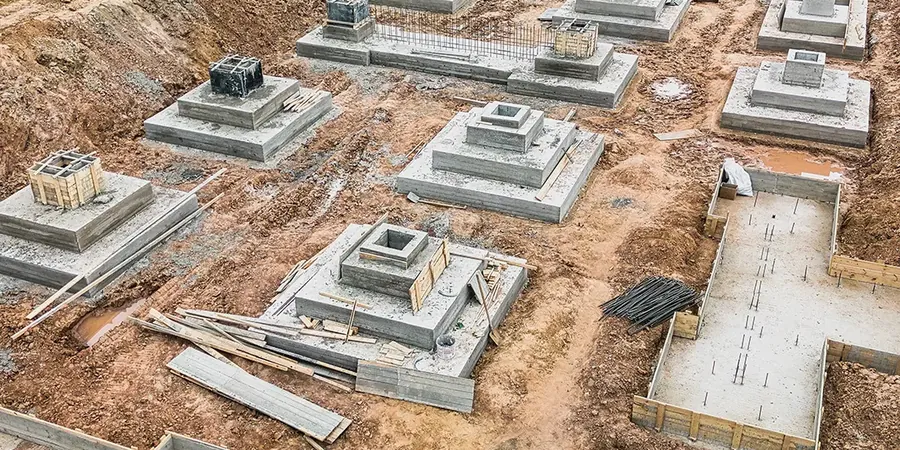
Risks and considerations in Darwin
On a project in Stuart Park we watched a contractor drive steel piles to refusal, only to have three of them creep downward by 40 mm overnight. The culprit was a thin, saturated silt lens at 8 metres depth that hadn't shown up on the desktop study. Darwin's subsurface is full of these surprises: buried paleochannels running under suburbs, pockets of loose dredge fill from the 1980s marina works, and zones where the water table sits less than a metre below the slab. Skipping a dedicated geotechnical investigation before piling is a gamble that can cost far more than the investigation itself. We've seen projects where undocumented fill led to pile groups being redesigned mid-construction, adding weeks to the program. The risk compounds in cyclone-rated buildings, where pile failure under lateral load isn't just a serviceability problem, it's a life-safety issue. AS 2159 requires a minimum factor of safety of 2.0 on ultimate geotechnical capacity for static loads, and we apply that rigorously, but we also insist on dynamic testing using PDA equipment to confirm capacity on at least one pile per group before signing off.
Our services
Our pile design service in Darwin covers the full chain from site investigation through to construction-phase monitoring. Each project draws on local drilling logs, laboratory test data from our NATA-accredited soil lab, and a practical understanding of how Top End soils behave under load.
Cyclonic pile group design
Lateral load analysis for wind speeds up to 88 m/s (Region C), with p-y curves calibrated to Darwin claystone stiffness. Includes pile cap reinforcement detailing and ground beam tie-in design.
Pile integrity and capacity testing
Cross-hole sonic logging (CSL), low-strain PIT testing, and high-strain dynamic PDA testing on driven and bored piles. NATA-compliant reporting with CAPWAP signal matching.
Reactive soil pile specification
Design of belled piles and straight-shaft piles with slip layers for sites with Iss values above 3.5%. Includes concrete durability specification for saline and sulfidic groundwater conditions common in Darwin's coastal suburbs.
Frequently asked questions
How deep do piles need to go in Darwin's reactive clay?
Most residential piles in Darwin's northern suburbs socket 1.5 to 2.5 metres into weathered phyllite or claystone, typically reaching depths of 12 to 18 metres below ground level. The exact depth depends on the shrink-swell index of the clay profile and the structural loads. We determine socket length from CPT refusal data and laboratory swell testing, not from a rule of thumb.
What's the difference between bored piles and driven piles for Darwin conditions?
Bored piles are more common in built-up residential areas because they generate less vibration and noise. Driven H-piles offer better performance in loose saturated sands where casing collapse is a risk, but they can be problematic near neighbouring structures. We select the pile type based on ground conditions, site access, and proximity to sensitive infrastructure.
Do I need pile design for a single-storey home in Darwin?
If your site has highly reactive clay with an Iss above 3.0%, or if it falls within a cyclonic wind classification zone, a piled foundation is strongly recommended. Many single-storey homes in suburbs like Karama and Malak are built on bored pier-and-beam systems to avoid slab cracking from seasonal ground movement.
What does pile foundation design cost for a residential project in Darwin?
For a typical Darwin residential project, pile foundation design including geotechnical investigation, structural engineering, and construction-phase testing generally ranges from AU$2,920 to AU$9,730 depending on the number of piles, depth to rock, and testing requirements. A four-pile group with PDA testing sits at the lower end; larger groups with CSL testing push toward the upper end.
How does cyclonic wind affect pile design in the NT?
Cyclonic wind loads create significant lateral forces and uplift at the pile head. Under AS/NZS 1170.2 Region C, our designs check ultimate lateral deflection against a serviceability limit of 25 mm. We typically deepen the socket and increase the reinforcement ratio in the upper 3 metres of the pile to handle moment transfer. Group effects are modelled explicitly rather than using simplified reduction factors.