The most expensive phone call a developer in Darwin can get is from their earthworks contractor halfway through a cut, saying the batter slopes are moving and they don't know why. Usually, the root cause traces back to a single missing step: nobody ran a proper triaxial test on the residual clay before design. Darwin sits on deeply weathered profiles, and the friction angles we see here often drop 15-20% from what a textbook SPT correlation would suggest. Our laboratory sees samples arrive from Palmerston, Berrimah, and Wickham Point regularly, and the pattern is consistent. Getting actual drained and undrained strength parameters under laboratory-controlled conditions changes the entire stability model, especially once the Wet kicks in and pore pressures spike. It is not just about compliance with AS 1726; it is about keeping a site open when the monsoon tests it for real.
A single triaxial test on an undisturbed Darwin clay sample can replace a dozen SPT correlations, reducing the factor of safety uncertainty by half.
Technical details of the service in Darwin
Risks and considerations in Darwin
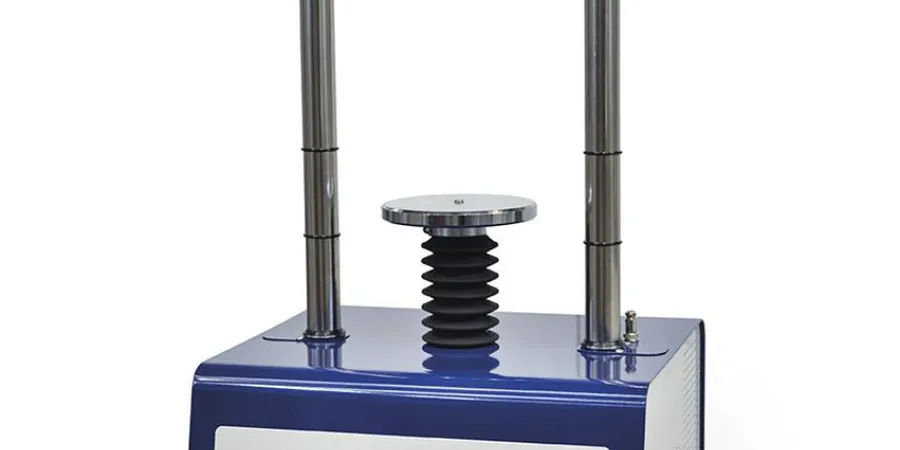
The triaxial cell on the bench in our Winnellie lab is a steel and perspex pressure vessel running oil-confined water around a latex-sheathed specimen. It looks sturdy, but back in the field, the consequences of skipping this test are anything but contained. Darwin's coastal suburbs, from Nightcliff to Bayview, sit on sands and soft clays that can liquefy or yield under lateral load. Without measured undrained shear strength from triaxial compression, a retaining wall designed on assumed parameters can rotate enough to crack the pavement behind it. And in the rural area around Howard Springs, where deep cuts expose weathered phyllite, a shallow failure circle modeled without effective stress cohesion triggers a real slip that takes the access road with it. The rainfall intensity in the Top End, routinely exceeding 60 mm in an hour during a storm, turns a marginal slope into a failure statistic if the drained strength envelope was never verified in the lab.
Our services
We couple the triaxial program with other field and lab methods to build a complete ground model for Darwin conditions.
Undisturbed Sampling for Triaxial Specimens
We push thin-walled Shelby tubes in Darwin clays and coordinate immediate transport to the lab, preserving natural moisture and structure. Sample extrusion, trimming, and quality logging follow AS 1289.1.2.1 to give the triaxial cell a specimen that truly represents the in-situ material.
Stress Path and Pore Pressure Analysis
Beyond the standard Mohr-Coulomb envelope, we provide p-q stress path interpretation and pore pressure coefficient (A and B) tracking. This helps Darwin's structural engineers model consolidation and undrained bearing capacity with better resolution than a single shear strength number.
Frequently asked questions
How long does a consolidated-undrained triaxial test take for Darwin clays?
A CU triaxial with pore pressure measurement on a Darwin clay specimen typically runs 3 to 5 working days from saturation to shearing. The consolidation phase is the longest step, because local estuarine clays often have low permeability and need time to equalize excess pore pressure under the effective confining stress. We monitor volume change and pore pressure continuously so the engineer knows the sample reached equilibrium before shearing starts.
What is the typical cost range for a triaxial test on a Darwin project?
For a standard set of three specimens to define a Mohr-Coulomb envelope, the cost ranges from AU$2,900 to AU$4,580 depending on the test type (CU vs. CD), confining pressures, and sample preparation effort. We quote per program rather than per specimen, so the report includes the full stress-strain dataset, p-q diagrams, and interpretation notes ready for the design engineer.
Can you test saturated sandy soils from Darwin's coastal suburbs?
Yes, we run triaxial compression on reconstituted or undisturbed sandy specimens from coastal Darwin. For loose sands prone to liquefaction, we often recommend a CU test with pore pressure measurement to capture the undrained response and estimate the critical state friction angle. The specimen is saturated using back pressure until the Skempton B-value reaches 0.95 or better, which is critical for getting reliable undrained strength data.