We see it all the time in Darwin. A contractor builds on what looks like solid ground, then the wet season hits, the water table rises, and suddenly the soil isn't behaving as expected. The problem is rarely the construction itself. It's that the site investigation skipped the Standard Penetration Test in favour of cheaper, less reliable methods. SPT testing in Darwin isn't optional if you're dealing with the loose, saturated sands common across the northern suburbs. The method gives you a direct measure of penetration resistance (N-value) that correlates with bearing capacity, settlement potential, and liquefaction susceptibility. For projects from Stuart Park to Palmerston, understanding what's beneath the surface before the monsoons arrive is the difference between a straightforward build and an expensive remediation job. Our team provides SPT drilling services across the Darwin region, including remote sites on the Cox Peninsula.
An SPT N-value below 5 in saturated sand in Darwin is a red flag for liquefaction risk during the wet season.
Technical details of the service in Darwin
Risks and considerations in Darwin
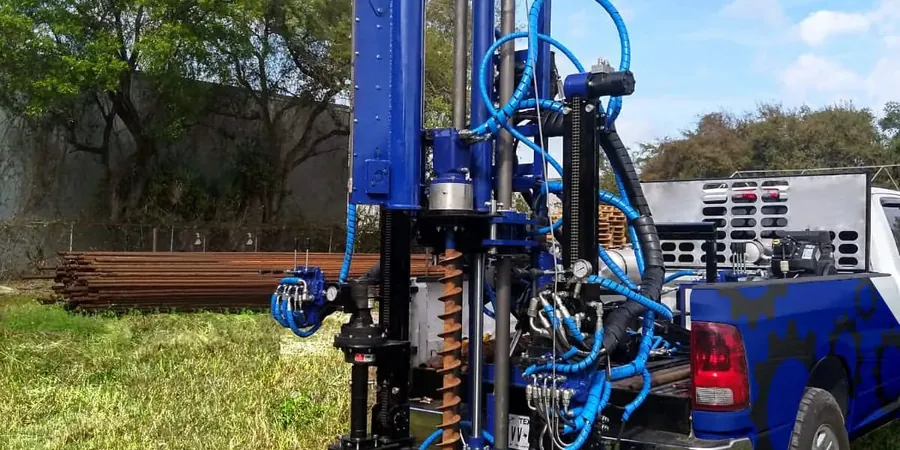
The rig we use in Darwin is a truck-mounted or track-mounted drill capable of penetrating through hard laterite caprock that sits atop softer sediment layers in the northern suburbs. It's not a light machine, and it needs accessible ground with enough clearance for the mast. The biggest risk in this environment isn't the drilling itself; it's making decisions without enough SPT data. In the Darwin region, soil conditions can change from one lot to the next, and what worked for a neighbour's slab might be completely inappropriate for yours. A low blow count at 3 metres depth in a saturated silty sand, combined with a high water table in February, can reduce allowable bearing pressure to levels that make a standard strip footing unsafe. That's not a hypothetical. We've seen it in Jingili, in Nightcliff, in Rapid Creek. The cost of skipping SPT testing or reducing the number of boreholes is a foundation that settles unevenly after the first monsoon season.
Our services
Our Darwin SPT testing service covers the whole project lifecycle, from preliminary site assessment through to foundation design verification. We operate across the Greater Darwin area and can mobilise to rural and remote sites in the Top End.
Standard SPT Boreholes
Single or multi-borehole programs with split spoon sampling at regular depth intervals. Includes field logging, N-value recording, and sample recovery for lab classification.
SPT with Laboratory Testing
Combined SPT drilling and laboratory analysis on recovered samples, including grain size distribution, Atterberg limits, and moisture content to AS 1289 standards.
Site-Specific N-Value Reporting
Interpretative report with corrected N60 values, bearing capacity estimates, settlement analysis, and liquefaction screening for Darwin's seismic and groundwater conditions.
Frequently asked questions
How much does SPT testing cost in Darwin?
For most residential and light commercial projects in Darwin, SPT testing typically ranges from AU$800 to AU$1.140 per borehole. The final cost depends on access conditions, depth required, and whether the site is in a remote area like the rural outskirts or Cox Peninsula.
What depth do you test to for a standard Darwin house slab?
For a typical residential slab in Darwin, we usually drill to 4–6 metres, or until we hit refusal in competent material. If the site is near a creek line or in a known fill area, we may go deeper to confirm there are no soft layers that could cause differential settlement.
Do I need SPT testing if I'm building on elevated land in Darwin?
Yes. Even elevated sites in Darwin can have a shallow profile of weathered rock overlying softer material, or a variable groundwater table. The SPT tells you what's there and how dense it is. Skipping it on a hillside lot can lead to surprises during excavation.
How many boreholes do I need for a commercial site in Darwin?
There is no fixed number, but AS 1726 recommends a minimum of three investigation points for a building footprint. On larger commercial sites in areas like Berrimah or Winnellie, where fill history and soil variability are common, we typically recommend a grid pattern with four to six boreholes to capture lateral variation. More info.