In Darwin, soil behaviour changes dramatically between the dry season and the wet—clays that were rock-hard in August become grease-slick after the first monsoonal rain. We have seen earthworks crews lose a full day because the cut material turned out to be highly plastic clay that wrapped itself around scraper tyres. That is exactly why Atterberg limits testing matters here. The liquid limit, plastic limit, and plasticity index tell you how a soil will respond to moisture, which is the single biggest variable on any Top End site. Rather than guessing from colour or feel, we quantify the plasticity with grain-size distribution as a companion test, because the combination of fines content and plasticity drives subgrade performance in Darwin’s lateritic profiles and estuarine clays, where a plasticity index above 30 is not uncommon.
A plasticity index above 25 in Darwin's estuarine clays signals shrink-swell potential that will crack lightly-loaded slabs unless the footing design accounts for it.
Technical details of the service in Darwin
Risks and considerations in Darwin
The contrast between two Darwin suburbs tells the story: Nightcliff, sitting on its lateritic plateau, often yields low-plasticity silty clays that compact well and drain reasonably; Palmerston, however, is built partly on deep, highly plastic clays of the Darwin Formation that can swell enough to lift a lightly-loaded slab by 40 mm across a wet season. We have seen this differential movement tear brick veneer walls in homes less than three years old. Atterberg limits testing gives the design engineer the numbers needed to decide between a stiffened raft slab, deeper piers, or a suspended floor system. When the plasticity index exceeds 30 and the liquid limit is above 60, the soil falls into the high-expansive category, and standard waffle pod slabs may not be enough without additional site-specific design measures.
Our services
All Atterberg tests are performed in our Darwin laboratory under the same roof as the rest of our geotechnical testing program, which means your project benefits from integrated interpretation rather than a disconnected lab report. The three service packages below cover the typical needs of Top End residential, commercial, and infrastructure work.
Standard Atterberg Package
Liquid limit, plastic limit, and plasticity index for one sample. Suitable for single-lot residential classification to AS 2870. Includes plasticity chart and AS 1726 soil symbol in the report.
Borehole Profile Suite
Atterberg limits at 1 m depth intervals down the full borehole, paired with natural moisture content and liquidity index. Ideal for commercial footing design where shrink-swell profiles vary with depth.
Quality Assurance Batch Testing
Atterberg testing on imported fill or compacted layers at prescribed frequencies (e.g., one test per 500 m³). Used for earthworks QA on subdivisions and road embankments across the Darwin region.
Frequently asked questions
What does the Atterberg test cost in Darwin?
For a standard single-sample liquid limit, plastic limit, and plasticity index determination, budget between AU$90 and AU$170 depending on whether natural moisture content and liquidity index are included. Borehole profile suites are priced per metre of logged core tested, and volume discounts apply for batch QA programs on larger earthworks jobs.
How long does the lab take to return results?
Standard turnaround is 24 hours from sample receipt. We also run an expedited 6-hour service for urgent situations—common during the dry season when earthworks crews are waiting on classification to confirm they have reached a suitable founding layer before pouring concrete the next day.
Why does Darwin soil need Atterberg testing more than southern cities?
Darwin's tropical residual soils and estuarine clays undergo extreme seasonal moisture cycles, from near-saturated during the monsoon to desiccated and cracked in the dry. This produces shrink-swell movements that are far more pronounced than in temperate southern cities. The plasticity index is the key predictor of that movement, so skipping Atterberg testing on a Darwin site carries a significantly higher risk of slab distress than it would in Melbourne or Adelaide.
How much sample do you need for an Atterberg test?
We need at least 150 grams of material passing the 425 µm sieve, taken from a representative disturbed sample and sealed immediately to preserve natural moisture if the liquidity index is also required. If the sample has dried out during transport, we can still determine the plastic and liquid limits, but the natural water content will be lost.
Do you test to AS 1289 or ASTM standards?
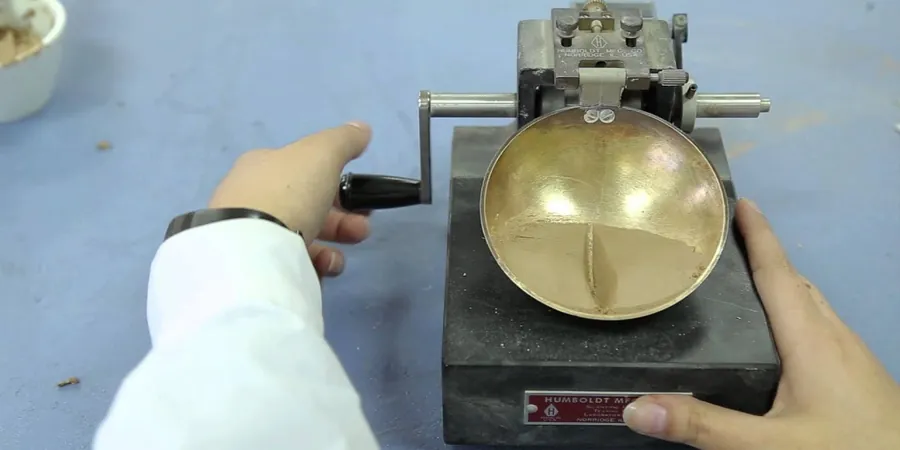
Our primary accreditation is to AS 1289.3.1.1 and AS 1289.3.2.1, which are the standards referenced by AS 2870 for residential slab design and by AS 1726 for geotechnical site investigation in Australia. We can also test to ASTM D4318 when required for international consultants or Defence projects, though the Casagrande cup method is common to both standards.