When Cyclone Tracy flattened much of Darwin in 1974, the reconstruction that followed reshaped not just the city skyline but also the engineering approach to its notoriously difficult ground. Today, Darwin’s urban expansion pushes into areas underlain by deeply weathered lateritic profiles, soft estuarine clays, and seasonally active expansive soils. Shallow foundation design here demands more than standard bearing-capacity checks. Our team combines borehole data with laboratory strength testing to develop footings that account for the 1,800 mm of annual rainfall and the aggressive wet-dry cycles that degrade near-surface materials. A proper shallow foundation design in Darwin must also consider the rapid runoff from the wet season, which can scour adjacent to pads and strip footings within days if drainage is overlooked. We work directly with local excavators and structural engineers to ensure that the ground model developed in the office matches the material exposed in the cut, reducing surprises during construction.
Darwin's laterite duricrust can carry 300 kPa, but seasonal suction changes demand reinforcement detailing that anticipates 40 mm of edge heave.
Technical details of the service in Darwin
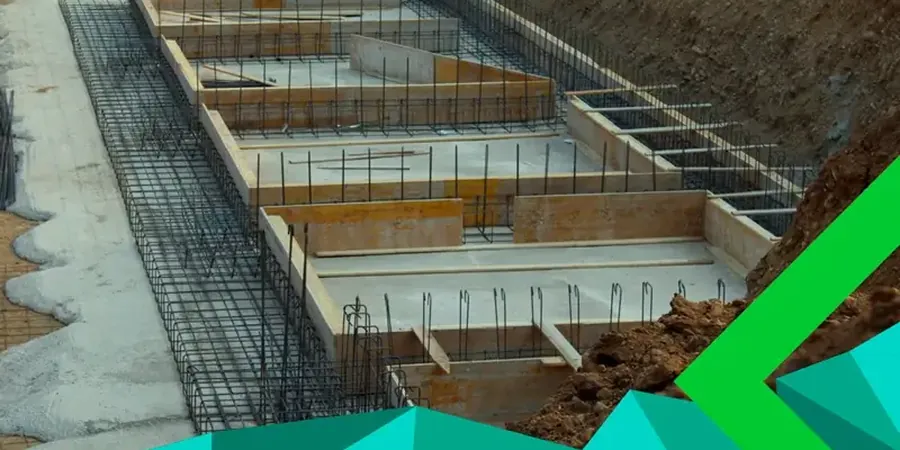
Risks and considerations in Darwin
The rig we mobilise in Darwin is a lightweight track-mounted Geoprobe 7822DT, selected specifically because it can access tight suburban blocks in Nightcliff or Rapid Creek without destroying established landscaping. It pushes 75 mm continuous cores through the desiccated crust and into the underlying weathered rock, giving us a continuous profile of the material that will support the footing. Skipping this step and relying on a desktop soil map is a gamble: isolated pockets of soft montmorillonite clay can lurk beneath a metre of gravelly fill, invisible from the surface. Shallow foundation design on unverified ground in Darwin can produce differential settlement exceeding 25 mm within the first three wet seasons. That is enough to crack brick veneer and bind doors, triggering costly remedial underpinning. We also test for aggressive soil chemistry: low resistivity readings below 10 ohm-m indicate high corrosion potential, which dictates concrete cover and cement type per AS 2159.
Our services
Shallow foundation design for a Darwin project typically encompasses two integrated work phases, each aligned with the site conditions encountered and the structural demands of the building system.
Site investigation and soil reactivity assessment
We execute a targeted drilling and sampling program to AS 1726, retrieving representative samples from the proposed bearing stratum. Laboratory testing yields the full suite of index properties—Atterberg limits, linear shrinkage, particle size distribution—needed to classify the site per AS 2870 and calculate characteristic bearing pressures for shallow foundation design. In Darwin’s lateritic terrain we pay particular attention to the depth to competent duricrust and the presence of any relict jointing that could concentrate water ingress.
Bearing capacity and settlement analysis
Using the site-specific shear strength parameters derived from unconsolidated undrained triaxial tests or pocket penetrometer profiling in the field, we perform analytical bearing capacity calculations under drained and undrained conditions per AS 4678. Settlement is assessed using Janbu’s strain influence method, accounting for the stiffening effect of the desiccated crust. The output is a set of dimensioned footing schedules and reinforcement layouts that satisfy both ultimate limit state and serviceability criteria for Darwin’s cyclonic wind loads.
Frequently asked questions
What is the typical cost for a shallow foundation design and associated site investigation in Darwin?
For a standard residential block in Darwin, the combined site investigation, laboratory testing, and shallow foundation design report typically falls between AU$2,520 and AU$4,290. The final figure depends on the number of boreholes required, the depth to competent bearing material, and the complexity of the reactivity assessment.
How deep do footings need to be in Darwin's reactive clay soils?
In the highly reactive clay profiles common across Darwin's northern suburbs, AS 2870 typically requires a minimum embedment of 0.75 m below the finished ground surface for stiffened raft slabs and deeper for strip footings on Class H or E sites. During the geotechnical investigation we measure the depth of the active moisture zone—often 1.8 to 2.2 m in this climate—and set the founding depth below that level to minimise seasonal movement.
Can you design shallow foundations on laterite duricrust without removing the underlying softer material?
Yes, provided the duricrust layer is continuous, of sufficient thickness, and the loads are within its bearing capacity. Our investigation maps the crust thickness across the building footprint using closely spaced dynamic cone penetrometer tests. If the duricrust exceeds 1.2 m in thickness and the underlying material is not collapsible, we can design a shallow foundation system that bears directly on the crust, applying a reduction factor to account for potential softening at the base of the layer over the 50-year design life.