The ground conditions between Darwin’s northern suburbs and the rural blocks around Howard Springs present a study in contrasts. Near Nightcliff, deeply weathered Cretaceous siltstone produces fine-grained residual soils with surprising plasticity, while out east, sandy colluvium and lateritic gravels dominate. A standard penetration test might tell you blow counts, but it won’t reveal whether those fines are silts or reactive clays. That distinction matters when specifying pavement subgrades or foundation bearing layers in a city where the annual wet season saturates the upper two metres of the profile for months at a time. Our grain size analysis — combining mechanical sieve separation and hydrometer sedimentation per AS 1726 — provides the particle distribution curve that engineers need to classify these materials correctly. In a port city where imported fill and dredged marine sand are common in reclamation zones, this test is the first step toward understanding drainage, compaction potential, and long-term volume stability.
A sieve-only classification of a tropical residual soil is a half-diagnosis — the hydrometer reveals the clay fraction that governs shrink-swell behaviour during Darwin’s wet-dry cycles.
Technical details of the service in Darwin
Risks and considerations in Darwin
Darwin’s monsoonal climate imposes a rhythm on soil behaviour that directly affects the interpretation of grain size results. Six months of near-daily rainfall between November and April flush fines downward through the profile, creating natural layering that a single bulk sample can miss if the technician doesn’t log the extraction depth precisely. The alternative — a dry-season sample taken from desiccated, cracked clay — often over-represents the sand fraction because the aggregated clay lumps resist dispersion. We’ve seen projects where a dry-season gradation curve suggested a well-graded sandy soil, only for the wet-season re-test to reveal 35% fines once the aggregates broke down. That discrepancy changes the USCS group symbol from SW to SC, with consequences for permeability assumptions and slope stability calculations on cut batters. In the East Arm and Wickham Point areas, where acid sulfate soils occur within Holocene estuarine muds, the grain size analysis also supports the screening protocol by identifying the silt-clay fraction that hosts pyrite. A project in Palmerston lost weeks to redesign because the initial investigation skipped the hydrometer step and underestimated the compressibility of the foundation layer.
Our services
The grain size analysis is rarely ordered in isolation. Our Darwin laboratory packages it with complementary tests to build a complete geotechnical profile:
Full Sieve + Hydrometer Package
Combined coarse and fine fraction analysis per AS 1289.3.6.1 and AS 1289.3.6.3. Includes washed sieving, sedimentation curve, and USCS classification with coefficient of uniformity and curvature.
Pre-Treatment for Problematic Soils
Chemical pre-treatment protocols for organic soils, acid sulfate materials, and highly aggregated tropical clays. Hydrogen peroxide oxidation and controlled dispersion ensure the hydrometer curve reflects true primary particle size.
Hydrometer-Only Fine Fraction Analysis
For projects where the coarse fraction is already characterised, a standalone hydrometer sedimentation test determines silt and clay percentages for correlation with Atterberg limits and soil reactivity classification.
Particle Distribution for Pavement Design
Gradation curves optimised for Austroads pavement material specifications. Reports include percentage passing key sieves (19.0, 9.5, 4.75, 2.36, 0.425, 0.075 mm) for basecourse and subgrade compliance checks.
Frequently asked questions
What is the typical cost for a combined sieve and hydrometer analysis in Darwin?
For a standard combined analysis (sieve stack plus full hydrometer sedimentation curve), budget between AU$160 and AU$260 per sample, depending on whether pre-treatment for organic or acid sulfate materials is required. Most Darwin projects submit batches of three to six samples, which reduces the per-unit rate. The price includes the particle size distribution chart, D10/D30/D60 values, uniformity and curvature coefficients, and a USCS classification letter symbol.
How does the hydrometer test work for the fine fraction below 75 microns?
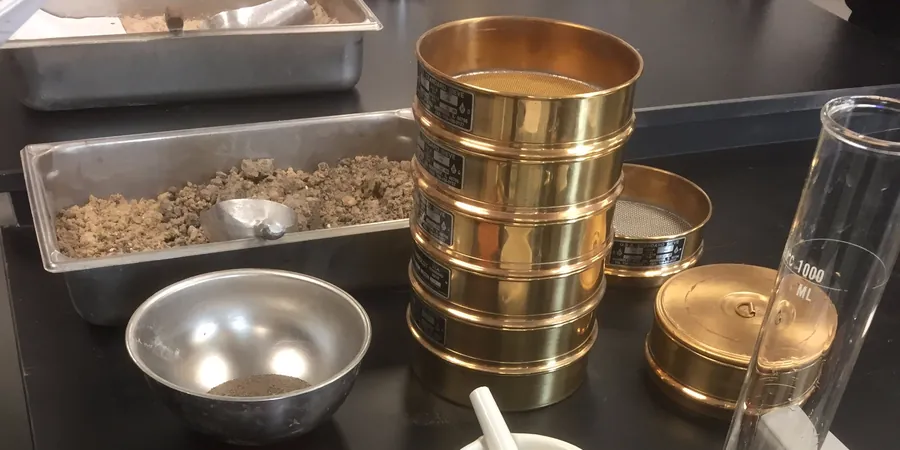
The minus-75 µm material is suspended in a 1000 mL cylinder with a dispersing agent. A 152H hydrometer is lowered into the suspension at timed intervals, and the reading — corrected for temperature and meniscus — gives the density of the suspension at a known depth. Stoke's law converts the settling time to equivalent particle diameter, assuming spherical particles and a specific gravity of 2.65. The method detects particles down to approximately 0.001 mm, capturing the full clay fraction that sieves cannot measure.
Why is the hydrometer step necessary for Darwin's residual soils?
Darwin's lateritic and siltstone-derived residual soils often contain aggregated clay particles that do not separate during dry sieving. A sieve-only analysis can under-report the fines content by 15 to 25 percentage points. The hydrometer step, with chemical dispersion, breaks these aggregates and reveals the true clay fraction — the portion responsible for shrink-swell behaviour during the wet-dry cycle. Without it, foundation designs and pavement thickness calculations risk underestimating the soil's volume change potential.