AS 1726 demands reliable in-situ hydraulic conductivity data before any deep excavation or retaining structure goes ahead in Darwin. The monsoonal cycles here mean groundwater levels swing drastically between the Wet and Dry seasons. A desk study alone won't cut it. We run Lefranc tests in soil and Lugeon tests in rock to measure permeability where it matters—at depth, under actual field conditions. These values feed directly into dewatering plans, cutoff wall design, and grouting specifications. Without them, you’re guessing on flow rates, and in Darwin’s saturated lateritic profiles, that’s an expensive risk.
Permeability isn't a number you look up in a table. In Darwin, it changes after the first big rain, and the only way to know is to measure it in situ.
Technical details of the service in Darwin
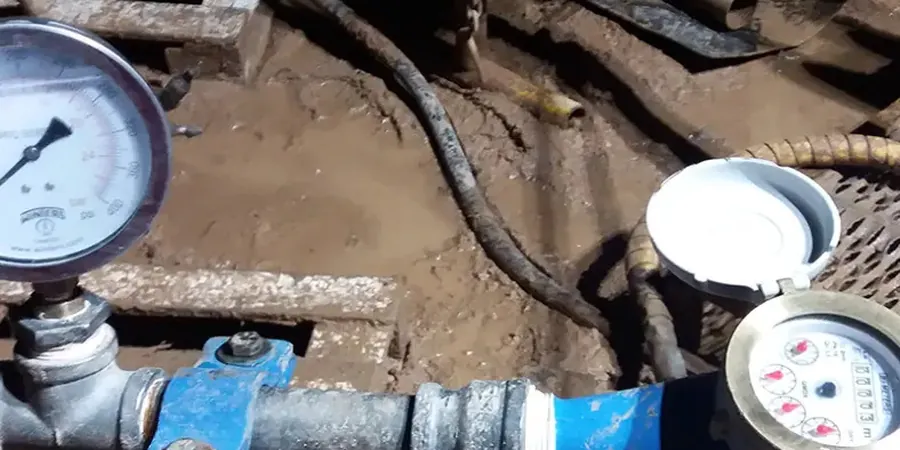
Risks and considerations in Darwin
Darwin’s Wet season turns a manageable seepage problem into a flooded excavation within hours. The region averages over 1,700 mm of rain annually, nearly all of it falling between November and April. If you haven’t quantified the mass rock permeability before dewatering design, your sump pumps will be undersized from day one. We’ve seen projects where incorrectly assumed K-values led to slope instability in temporary batters and repeated delays. A proper Lugeon test through the weathered zone identifies high-conductivity fractures early, so you can budget for grouting or wellpoint systems before the first storm hits.
Our services
Our Darwin field permeability service covers the full workflow from borehole preparation to interpreted hydraulic conductivity profiles:
Lugeon packer testing
Five-pressure-stage test in rock boreholes. Identifies fracture flow regime, dilation, and critical pressure thresholds for grouting design.
Lefranc permeability
Constant-head or variable-head tests in soil boreholes. Isolates a test section below casing for accurate K-value measurement.
Falling-head / rising-head tests
Simple in-situ tests for monitoring wells and standpipes. Quick verification of hydraulic conductivity for long-term groundwater monitoring.
Permeability profiling and reporting
Interpreted results with P-Q plots, Lugeon values, and K-depth profiles. Ready for direct input into dewatering and seepage models.
Frequently asked questions
What’s the difference between a Lefranc test and a Lugeon test?
A Lefranc test measures permeability in soil, typically using a constant or falling head method in a borehole section below the casing. A Lugeon test measures permeability in rock by injecting water under pressure through a packer-isolated interval. Lugeon tests use five pressure stages and are standard for assessing bedrock groutability. Both are covered under AS 1726 for site investigations.
How much does a field permeability test cost in Darwin?
Field permeability testing in Darwin typically ranges from AU$940 to AU$1,770 per test zone, depending on depth, number of pressure stages, and whether a Lefranc or Lugeon setup is required. Mobilisation and borehole preparation are quoted separately based on site access and ground conditions.
At what depth do you run the Lugeon test in rock?
We isolate test sections typically between 3 and 6 metres in length, starting below the weathered rock interface. In Darwin’s lateritic profiles, the first competent rock can be anywhere from 2 to 15 metres deep, so we log the core first, then pick packer seats where the RQD justifies a sealed interval. Deeper stages follow as drilling progresses.
How long does a permeability test take on site?
A single Lefranc test can be completed in 30 to 60 minutes once the borehole is prepared. A full five-stage Lugeon test typically takes 60 to 90 minutes per test interval. The limiting factor is often borehole stability in Darwin’s collapsible sands; we may need to case off or use polymer mud before testing, which adds rig time.