In-situ testing in Darwin addresses the unique geotechnical challenges presented by the region's deeply weathered phyllite, lateritic profiles, and seasonally active estuarine clays. Direct field assessments are critical for reliable foundation design, with methods closely aligned to AS 1726 and local Northern Territory government specifications. A primary service for earthworks verification is the field density test (sand cone method), which confirms compaction compliance in the problematic silty sands and residual soils common across the Top End.
These investigations are mandatory for both urban infrastructure in developing suburbs like Holtze and for remote civil works where uncontrolled fill is prevalent. Ground-truthing through in-situ data is essential before placing footings on reactive clays or designing pavements subject to monsoonal moisture cycles. This category also supports integrity assessments for deep foundations, often paired with dedicated pile integrity testing to validate structural capacity in Darwin's variable ground conditions.
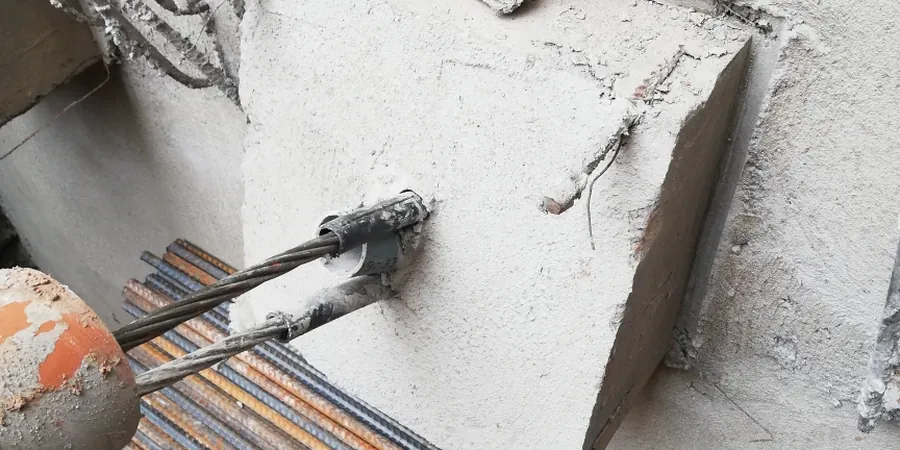
In Darwin's lateritic profile, the transition from Grade V to Grade III weathered rock often dictates the anchor bond length, not the structural tendon capacity.
Technical details of the service in Darwin
Key design considerations we apply:
- Creep behavior verification in over-consolidated claystone layers found below 8 m depth in the Darwin CBD.
- Cyclonic uplift resistance for tie-down anchors, often integrated with deep excavation monitoring when multi-level anchoring is required near existing structures.
- Load testing protocols including proof and suitability tests on sacrificial anchors before production drilling begins.
Risks and considerations in Darwin
Darwin’s urban development evolved rapidly after Cyclone Tracy in 1974, with much of the northern suburbs built on estuarine mud flats and reclaimed mangrove swamps. These compressible soils can undergo long-term settlement that imposes downdrag forces on passive anchors if the free length is not properly isolated. The biggest technical risk we encounter is the misidentification of the active failure wedge in excavations deeper than 6 meters; in the Darwin context, where the residual clay can appear competent but contains relict joints from the parent rock, a planar failure surface can form unexpectedly. To mitigate this, we often pair the anchor design with a slope stability analysis that models the relict joint sets measured during the geotechnical investigation, ensuring the bonded length extends well beyond the critical slip circle.
Our services
We provide anchor design and verification services for projects across the greater Darwin area, from temporary shoring for service trenches to permanent retention for basements in the Waterfront Precinct. Each design is accompanied by a detailed construction specification.
Temporary Ground Anchors
Design of strand or bar anchors for sheet pile and soldier pile excavation support during the dry season construction window (May-October). Includes tendon selection for reuse where possible.
Permanent Tie-Down Anchors
Post-tensioned anchors for uplift resistance on foundations subject to cyclonic wind loads, with full encapsulation and monitoring access tubes for long-term load verification.
Anchor Load Testing & Verification
On-site supervision of proof, suitability, and acceptance tests per AS 4678, with load-displacement plotting and residual load assessment using lift-off checks.
Frequently asked questions
What is the difference between active and passive anchors in retaining wall design?
An active anchor is pre-tensioned to a specified lock-off load, typically 80-110% of the design working load, to actively restrain the wall and limit deflections before excavation proceeds further. A passive anchor is not prestressed; it only develops resistance as the wall moves and soil deformation occurs. In Darwin, active anchors are preferred for permanent works near sensitive structures in the CBD because they control lateral movement within 10-15 mm, whereas passive anchors might allow 30-50 mm of movement before reaching full capacity.
What is the typical cost range for an anchor design package in Darwin?
A full anchor design package including geotechnical interpretation, bond length calculations, and construction-ready drawings typically falls between AU$1,830 and AU$5,710, depending on the number of anchor levels, the complexity of the corrosion protection class required, and whether load testing supervision is included. Projects with multiple wall sections and varied ground conditions fall at the upper end of this range.
How far into the rock does the bond length need to extend in Darwin's laterite profile?
The bond length must extend a minimum distance past the theoretical failure plane, but in Darwin's lateritic profile, the key is anchoring into Grade III or better rock. The duricrust cap (Grade IV-V) has highly variable cementation and should not be relied upon for permanent bond unless proven by suitability tests. We typically design for a minimum 5-meter bond length in the underlying phyllite or siltstone, verified by a pull-out test on a sacrificial anchor before production drilling begins.