Darwin's suburbs sit on a weathered mantle of silty clays and lateritic gravels that can move a surprising amount between the wet and dry seasons. The annual rainfall of nearly 1,700 mm saturates the upper profile, while the seven-month dry spell shrinks it back, creating ground movement that tears apart stiffened rafts if the design misreads the reactivity. We work directly with this soil behaviour, combining deep site classification to AS 2870 with in-situ permeability testing where drainage paths may concentrate moisture under the slab. For sites near the harbour margin, where soft estuarine clays appear within two metres of surface, we also integrate CPT soundings to map the compressible layer before setting the raft geometry.
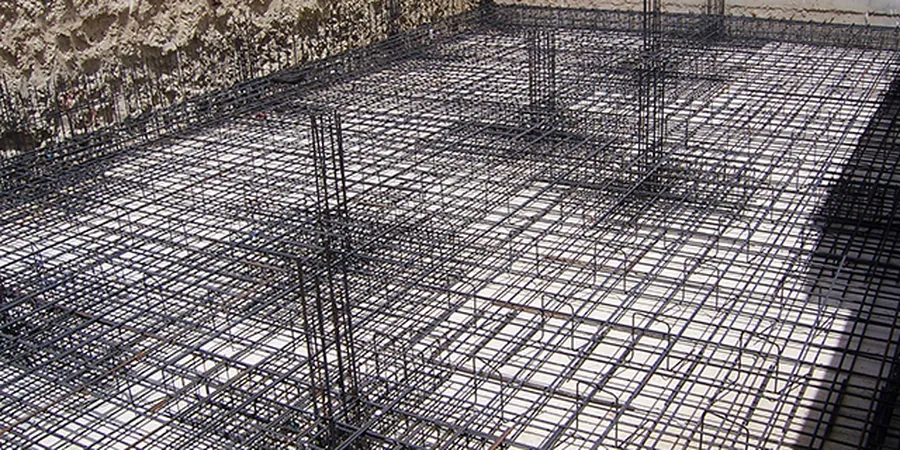
A properly designed raft in Darwin's reactive clay does not fight the movement; it moves as a single rigid unit and keeps the superstructure intact.
Technical details of the service in Darwin
Demonstration video
Risks and considerations in Darwin
Darwin's post-Cyclone Tracy rebuild in the mid-1970s pushed housing onto land that had barely been developed before, and some of those subdivisions sit on deep clay profiles that were poorly understood at the time. Today, older slab-on-ground homes in suburbs like Rapid Creek show telltale cracking from decades of wet-dry cycling. The risk is not just cosmetic: differential movement beyond about 40 mm can rack door frames, shear brick veneer ties, and rupture in-slab plumbing. A raft foundation designed to the current AS 2870 site classification absorbs this movement without distress, provided the geotechnical investigation captures the full depth of moisture variation. Cutting corners on the borehole depth or ignoring the suction profile in the upper two metres is a false economy that shows up within the first three wet seasons.
Our services
Our Darwin geotechnical team delivers the full chain from site investigation through to signed Form 15 design certification for raft and mat foundations. Each package is calibrated to the specific reactivity class and cyclonic wind zone of the site.
Site Classification to AS 2870
Drilling, sampling, and laboratory swell testing to determine the site reactivity class (S, M, H1, H2, or E) and the characteristic surface movement ys for input into the raft design.
Raft Geometry & Reinforcement Design
Stiffened raft layouts with internal beam grids, thickened edge beams, and detailed bar schedules developed for the design ground movement and the specific dwelling footprint.
Construction-Phase Inspection & Testing
Subgrade proof rolling, fill compaction testing to AS 3798, reinforcement placement checks, and concrete slump/cylinder testing during the pour to confirm design assumptions are met on site.
Frequently asked questions
How much does a raft foundation design cost for a residential block in Darwin?
For a standard suburban lot, the combined geotechnical investigation and structural design package typically falls between AU$1,600 and AU$6,200. The range depends on the number of boreholes required, the reactivity class found, and whether the dwelling is single-storey or two-storey. Sites needing deeper investigation because of soft estuarine clays or uncontrolled fill will be at the upper end of that range.
What is the difference between a raft slab and a waffle pod slab in Darwin conditions?
Both are stiffened raft systems, but they behave differently in our monsoonal clay. A waffle pod slab uses polystyrene void formers between ribs and sits on a sand levelling layer; it works well on stable, well-drained Class S or M sites. A conventional stiffened raft with deep edge beams and internal beams cast directly onto the ground provides more rigidity and is our preferred solution for Class H1 and H2 sites, where the predicted ground movement exceeds 40 mm and edge heave from tree drying is a concern.
Do I need a raft foundation if my block is on sand rather than clay?
Not necessarily. Sandy sites in coastal suburbs like Nightcliff or Fannie Bay can sometimes use stiffened strip footings if the sand is dense and well-drained. However, if the sand is loose or contains soft clay layers within the zone of influence, a raft foundation spreads the load more evenly and prevents differential settlement. The decision comes from the borehole logs and CPT data, not from a rule of thumb.