AS 1289.5.3.1 sets the standard for field density determination in Australia, but applying it in Darwin means working with soils that change behavior dramatically between the wet and dry seasons. The sand cone method remains the most reliable way to verify compaction on-site when the ground shifts from dust to mud in a single afternoon. Our laboratory team runs these checks across Darwin’s northern suburbs, Palmerston, and the rural area, where lateritic gravels and sandy clays demand precise moisture-density relationships. Every test we perform ties back to the modified Proctor reference curve, because without that correlation the numbers mean nothing. In cyclone-prone Darwin, where footings must resist both seasonal heave and storm surge loading, compaction verification becomes a structural requirement, not just a box to tick. We also cross-check results with grain-size analysis when fill material sources vary across the site and the engineer needs to confirm the borrow pit still matches the original mix design.
A compaction test is only as good as the sand calibration that morning — skip it and you are guessing, not measuring.
Technical details of the service in Darwin
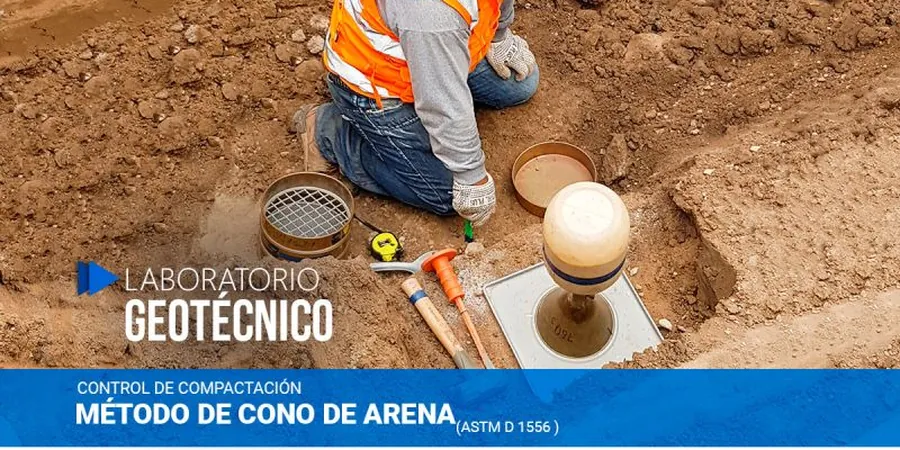
Our field kit travels in a dedicated vehicle with dessicant-sealed sand containers, because once the calibration sand cakes up from Top End humidity, the entire day’s results become suspect. Temperature matters too: sand volume changes measurably between a cool morning at 22°C and an afternoon at 35°C on a Darwin construction pad.
Risks and considerations in Darwin
Darwin’s urban expansion since Cyclone Tracy in 1974 reshaped the construction landscape, pushing residential subdivisions onto weathered Cretaceous sediments and deep lateritic profiles that earlier builders avoided. Those older neighborhoods on elevated ground had natural compaction from millennia of wet-dry cycling. The new subdivisions in Palmerston and the Litchfield corridor sit on cut-and-fill platforms where every imported lift needs mechanical compaction verified by field density testing. Undetected low-density zones in these fills create differential settlement paths that crack slabs within two or three wet seasons. In one recent subdivision near Coolalinga, post-construction testing revealed density ratios below 90% in three out of twelve pads, requiring rework before the builder could pour footings. Darwin’s monsoonal rains infiltrate poorly compacted fills fast, triggering collapse settlement when the soil structure dissolves under load. The sand cone method catches these weak zones because it measures a discrete point at the actual lift depth, unlike surface-only techniques that miss problems buried 200 mm down.
Our services
Field density testing in Darwin integrates with several complementary geotechnical services that together form a complete compaction assurance program for earthworks and pavement construction.
Modified Proctor Compaction Testing
Laboratory determination of maximum dry density and optimum moisture content per AS 1289.5.2.1. The reference curve against which all field density results are compared. We run single-point and five-point Proctor curves depending on material variability across the Darwin site.
Nuclear Gauge Density Correlation
Calibration of nuclear density gauges against sand cone results for faster production testing on large Darwin earthworks pads. Includes daily standard count checks and moisture offset determination for Top End lateritic soils.
Fill Material Compliance Testing
Grain-size distribution, Atterberg limits, and organic content analysis on imported fill before placement. Required when Darwin sites switch borrow sources mid-project and the engineer needs to confirm the new material still meets specification.
Frequently asked questions
How much does a field density test using the sand cone method cost in Darwin?
Field density testing with the sand cone method in Darwin typically ranges from AU$160 to AU$210 per test point, depending on site access, number of tests in the same visit, and whether moisture content determination is included on-site or requires laboratory oven drying. Projects with more than ten test points on the same day usually benefit from reduced per-point pricing.
How many sand cone tests are required per lift on a Darwin earthworks project?
AS 3798 recommends a minimum of one field density test per 500 square metres per compacted lift. On smaller residential pads in Darwin, this typically means three to six test points per house slab preparation, depending on pad size and the number of fill lifts placed.
Can the sand cone method be used when the fill contains gravel or ironstone?
Yes, the standard sand cone method works for materials with particles up to 20 mm. When Darwin lateritic fills contain ironstone gravel larger than 20 mm, we apply a rock correction factor per AS 1289.5.3.1. For fills dominated by coarse gravel, a larger replacement method or test pit excavation may be more appropriate.
How does Darwin's humidity affect sand cone test accuracy?
High humidity causes calibration sand to absorb moisture, which changes its bulk density and leads to systematic errors. We store calibration sand in sealed containers with desiccant, run calibration checks at the start and end of each day, and avoid testing during rain events when surface water can enter the excavated hole and invalidate the volume measurement.
What compaction standard applies to residential slabs in the Darwin area?
Residential slabs in Darwin are typically required to achieve 95% standard Proctor or 95% modified Proctor density ratio, depending on the engineer's specification and the site classification under AS 2870. The sand cone test provides the field density value that is compared against the laboratory reference to calculate this ratio.