AS 1726 classifies much of Darwin's near-surface stratigraphy as highly compressible estuarine clay, a legacy of the mangrove swamps that once covered the coastal lowlands. Designing stone columns through these deposits requires more than a generic spacing and diameter; it demands a detailed understanding of the undrained shear strength profile and the lateral confinement available at depth. With a population of roughly 150,000 spread across a tropical monsoon belt, Darwin's building stock is expanding into areas where the natural ground can lose half a metre of elevation under sustained load. The solution lies in combining rigorous site investigation with a stone column grid that transfers stress to a competent bearing stratum while providing a controlled drainage path. When the upper three to five metres of the profile consist of soft clay with interbedded sand lenses, the design must also account for the risk of fines migration into the stone column over time, a mechanism that can reduce its long-term stiffness if not addressed during the specification of the granular fill and the geotextile encasement. For projects requiring a more detailed stratigraphic profile prior to finalizing the column layout, the CPT test delivers a near-continuous log of tip resistance and sleeve friction that feeds directly into the design model.
In Darwin's deep estuarine clays, a well-designed stone column grid can reduce post-construction settlement by 60 to 80 percent while cutting consolidation time from years to months.
Technical details of the service in Darwin
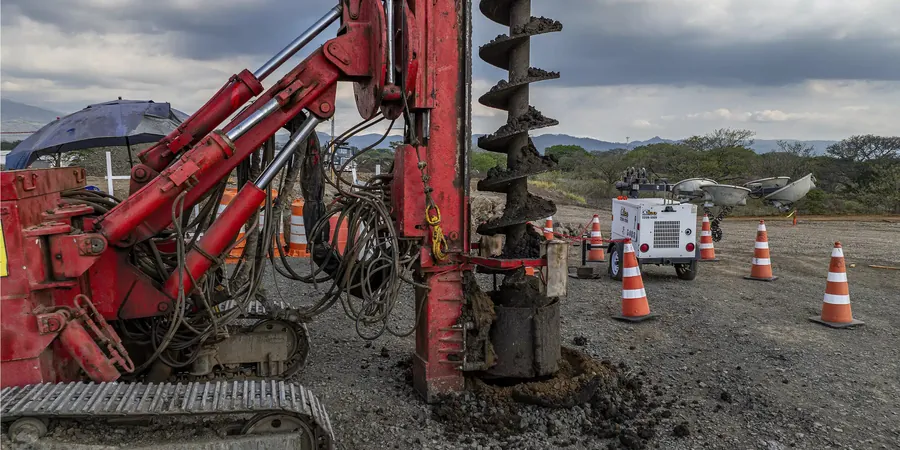
Risks and considerations in Darwin
An eight-storey mixed-use development planned on a former industrial site near Darwin's inner harbour encountered a 12-metre-thick layer of soft silty clay with an undrained shear strength averaging just 18 kPa. The geotechnical investigation revealed that a conventional shallow footing solution would produce total settlements exceeding 180 mm, with differential settlement between columns likely to crack the facade within the first two wet seasons. The stone column design prepared for this site had to address three simultaneous failure mechanisms: bearing capacity of the individual column, bulging failure within the upper portion of the soft clay where confining pressure is lowest, and the long-term settlement of the untreated soil between columns. The final design adopted a triangular grid of 900 mm diameter columns at 2.2 m spacing, extending to a depth of 14 m where a dense sand layer provided a firm bearing stratum. Post-installation plate load tests confirmed a modulus of subgrade reaction more than four times higher than the untreated ground, allowing the structural engineer to reduce the raft thickness by 120 mm and save the client significant concrete and steel costs.
Our services
Our stone column design service in Darwin covers the full workflow from geotechnical model development through to installation verification. Each phase is calibrated to the specific stratigraphy encountered on site and the performance criteria set by the structural engineer.
Geotechnical Design & Numerical Modelling
Development of the ground model using CPT and borehole data, followed by axisymmetric unit-cell analysis in PLAXIS or FLAC to determine the area replacement ratio, column spacing, and depth required to meet settlement and bearing capacity targets under AS 4678.
Stone Column Specification & Quality Control
Preparation of technical specifications for the stone column contractor covering aggregate gradation (AS 2758.1), installation method (wet or dry top-feed vibro-replacement), encasement requirements, and the field testing program including plate load tests and post-installation CPT verification.
Performance Verification & Instrumentation
Design and execution of the load testing program to confirm column stiffness and composite ground modulus, along with installation of settlement plates, piezometers, and inclinometers where required to monitor performance during and after construction.
Frequently asked questions
How much does a stone column design cost for a project in Darwin?
A complete stone column design package for a Darwin site, including geotechnical modelling, unit-cell analysis, and preparation of specifications, typically ranges from AU$2,480 to AU$9,170 depending on the complexity of the ground profile and the size of the treatment area. For smaller residential or light commercial projects, the lower end of this range is common. Larger industrial sites with deep soft clay and stringent settlement criteria, where advanced numerical modelling is required, tend toward the upper end.
What soil conditions in Darwin make stone columns the right choice?
Stone columns are particularly well-suited to the soft estuarine clays and silty deposits found across much of Darwin's coastal and low-lying areas. They are effective where the undrained shear strength is between 15 kPa and 50 kPa, and where the compressible layer is between 4 m and 25 m thick. In these conditions, stone columns provide a dual benefit: they increase the overall stiffness of the ground mass to control settlement, and they create vertical drainage paths that accelerate the dissipation of excess pore water pressure during construction.
How long does it take to complete a stone column design?
A typical stone column design for a Darwin project takes two to three weeks from receipt of the final geotechnical investigation data. This timeline covers the development of the ground model, the selection of design parameters, the axisymmetric unit-cell analysis, and the preparation of the specification and construction drawings. If the project requires three-dimensional finite element analysis for complex loading or geometry, an additional one to two weeks may be needed.
What quality control tests verify that the stone columns are performing as designed?
The primary field verification method is the plate load test, conducted on a single column and on a group of columns to confirm the modulus of subgrade reaction and the composite ground stiffness match the design values. Post-installation CPT soundings through the centre of selected columns verify the continuity and density of the stone column with depth. Additional checks include aggregate gradation testing per AS 2758.1 before placement and settlement monitoring during the loading period using survey points or settlement plates.